
We develop the power plant, the permit and the deal.
Behind-the-meter power for data centers and industrial loads. The permit sets the schedule and the schedule sets the economics, so we design around the permit from the start. We sell no equipment and no technology. Nothing is riding on the answer except getting it right.
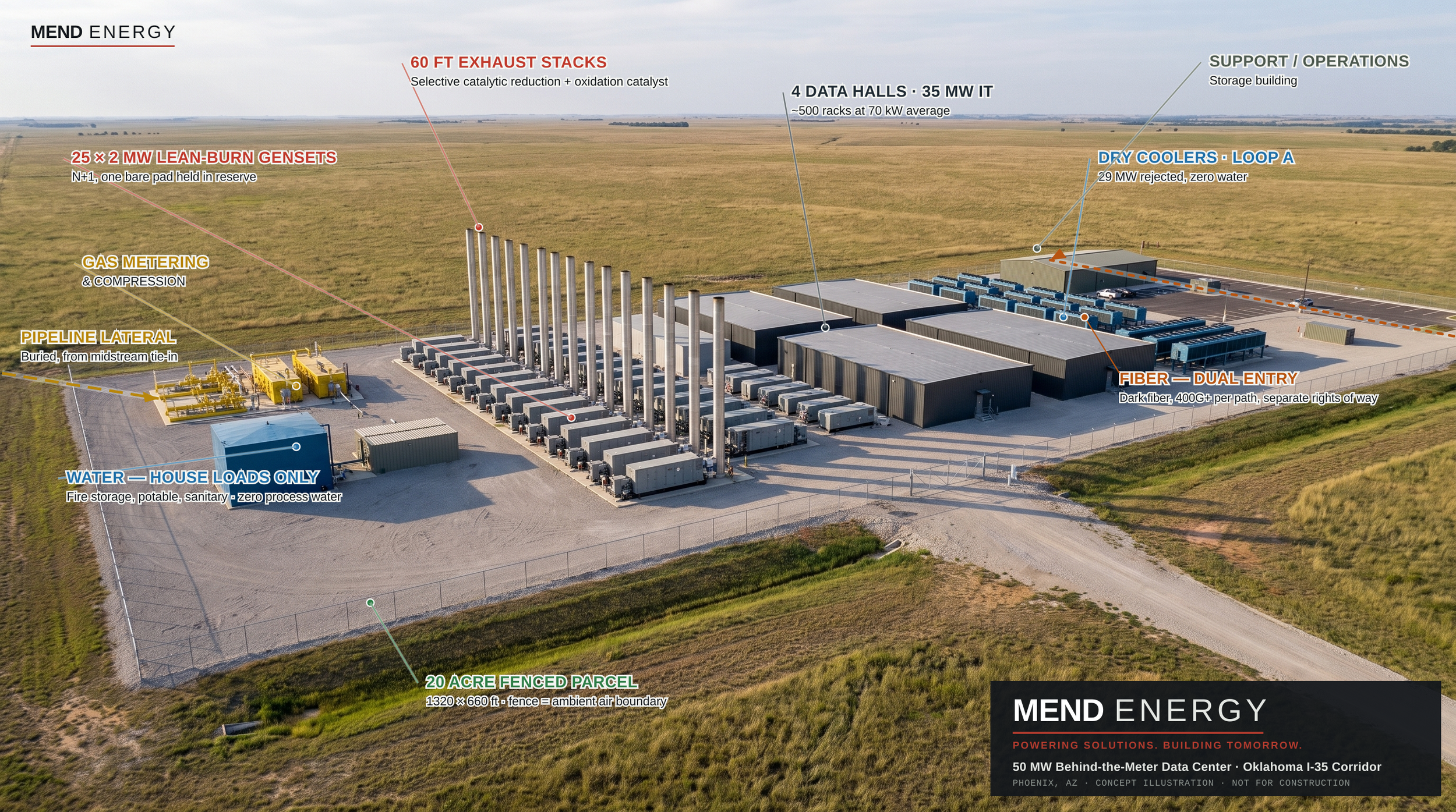
Four things we get hired to do
Project development
Site origination and powered land, gas-to-power screening, load ramp and phasing, behind-the-meter versus utility interconnection.
Permitting and technical
Air permit strategy, generation technology selection and specification, electrical and mechanical review, owner-side QA and QC over FEED and EPC packages.
Commercial structuring
Term sheets, power purchase and tolling agreements, ground and capacity leases, development agreements, counterparty diligence.
Technology advising
Independent engineering review of new and developing technologies, grounded in first principles rather than the pitch. Feasibility, cost and readiness, told straight.
The air permit is the schedule
We design the plant around the permit instead of applying for a permit around the plant. Getting that order right from the start is what moves a project fastest. The emissions profile is set before the equipment is locked, so the project qualifies for the quickest permitting route available to it.
On most sites the binding constraint is not the equipment. It is how the site is laid out and how the plant is configured. Settle those two early and the permit stays on the fast track.
Connected load is the revenue line. More permitted capacity on the same acreage means more racks, more throughput and more revenue from the same site.
Designed for the fast path
Emissions set at the start, so permitting runs on the quickest route available
A schedule you can hold
A permit timeline you can plan around and finance against
The same product on a constrained site
Open acreage is the easy version. The work that separates projects is the constrained infill site, where the property line is close enough that dispersion and acoustics drive the design before the equipment does.
In the Bay Area we are getting 49 MW to roughly 100 MW per acre on a tight infill site, and staying inside the emissions limits.
Footprint is a gate on infill land, not a cost tradeoff. If it does not fit, the project does not happen.
Powered land is anywhere the interconnection already exists
Everyone building compute is standing in the same queue for new capacity. The sites that skip it are the ones already connected, and it does not matter much what they were connected for.
A peaker or a demand response fleet. A battery site. A solar or wind project with capacity the resource never fully used. A factory or mill built around a service that outlived the plant. Different assets, same asset: steel in the ground, a permit history, and an interconnection that is energized today instead of in five years.
The work is figuring out what that interconnection and that air permit actually support, then building the load around what is already there. Existing generation usually converts to backup duty, which is what a data center needs anyway and what a greenfield site has to build from scratch.
Not every connected site clears. Capacity, permit headroom, land and fiber all have to line up. That screen is the first thing we do, and it takes weeks rather than quarters.
20+ years
Engineering and project development experience
300+ MW
Behind-the-meter generation in active development
Portfolio scale
Developer for an on-premise prime power program at a national industrial portfolio owner
Engineer and attorney
Technical case and commercial terms built together
Three ways to engage
Scoped deliverable
Fixed fee on a defined package: a permit screen, a technology comparison, a pricing model, a design review.
Monthly advisory
A retainer against defined scope. Best when you want a technical and commercial second seat across several sites at once.
Project participation
Largely contingent. We carry the development work and take a percentage of project revenue or a success fee at close.
Who we work with
Landowners and industrial owners turning a site into powered land. Developers and operators building data centers. Investors underwriting a project and needing an independent read. Technology companies that want an honest engineering opinion before they raise or spend.
We are not a manufacturer and we do not sell a technology. There is no product to move, so the recommendation is the recommendation.
Have a site, a project or a technology you want a second opinion on?
Ryan Kemmet, Principal
602-527-5480
Phoenix, Arizona